
How to Check Criminal History in Antrim County
No single official search produces a complete Antrim County criminal history. Start with the record closest to the event. MiCOURT holds public case information from participating courts. The 86th District Court handles misdemeanors, traffic-criminal matters, and the early stages of felonies. Bound-over felony cases move to the Antrim division of the 13th Circuit Court. Sheriff Administration and the county jail hold local incident, arrest, booking, and custody material. ICHAT adds the public Michigan repository view, while OTIS answers a narrower state custody or supervision question.
Gather the full name, date of birth, spelling variants, and a case or incident number when known. Use those details to separate similar names. Then compare the arrest charge with the prosecutor charge and final court result. Those labels can change as the case moves.
- Search MiCOURT Case Search and choose the correct Antrim court location.
- Ask the district or circuit clerk for the official file when the online result is old, unclear, or incomplete.
- Call the jail or ask Sheriff Administration for a recent booking or sheriff report that has not reached court.
- Use ICHAT for the public Michigan repository slice, then check its exclusions.
- Use OTIS only for current or recent MDOC custody, probation, or parole information.
Antrim County Four-Channel Record Trail
Each Antrim County criminal record channel answers a different question. The sheriff's report describes the incident and arrest. A jail record shows intake, bond, custody, and release status. A court file tracks filed counts, hearings, pleas, dismissal or conviction, and sentence. ICHAT compiles the public part of reportable Michigan history. OTIS begins to matter after an MDOC sentence or qualifying supervision, not while a person is held only in the county jail.
| Channel | Best use | Key limit |
|---|---|---|
| Sheriff and jail | Recent arrest, booking, custody, incident report | No public Antrim web roster was found |
| District or circuit court | Filed case, events, outcome, sentence | Online display is not the certified file |
| MSP ICHAT | Public reportable Michigan history | Omits warrants and several record classes |
| MDOC OTIS | State custody or qualifying supervision | Omits county-jail-only records |
A missing result in one system should prompt a check of the source office, not a broad claim that no record exists. Antrim County records can also lag while an arrest, charging decision, and disposition are matched.
Official Michigan Background Checks
Michigan State Police Criminal Justice Information Center runs ICHAT as a public name-based check. A search costs $10 and requires first name, last name, full date of birth, and sex or gender; the official tutorial also presents race as an identity field. It returns public Michigan information reported to MSP for felonies and serious misdemeanors punishable by more than 93 days. It is not fingerprint confirmed and does not search other states, federal or tribal files, warrants, juvenile matters, traffic files, local minor misdemeanors, or suppressed records.
The MSP criminal-history overview shows how the public product differs from fingerprint review. The official source also supplied this captured view of Michigan criminal-history channels.
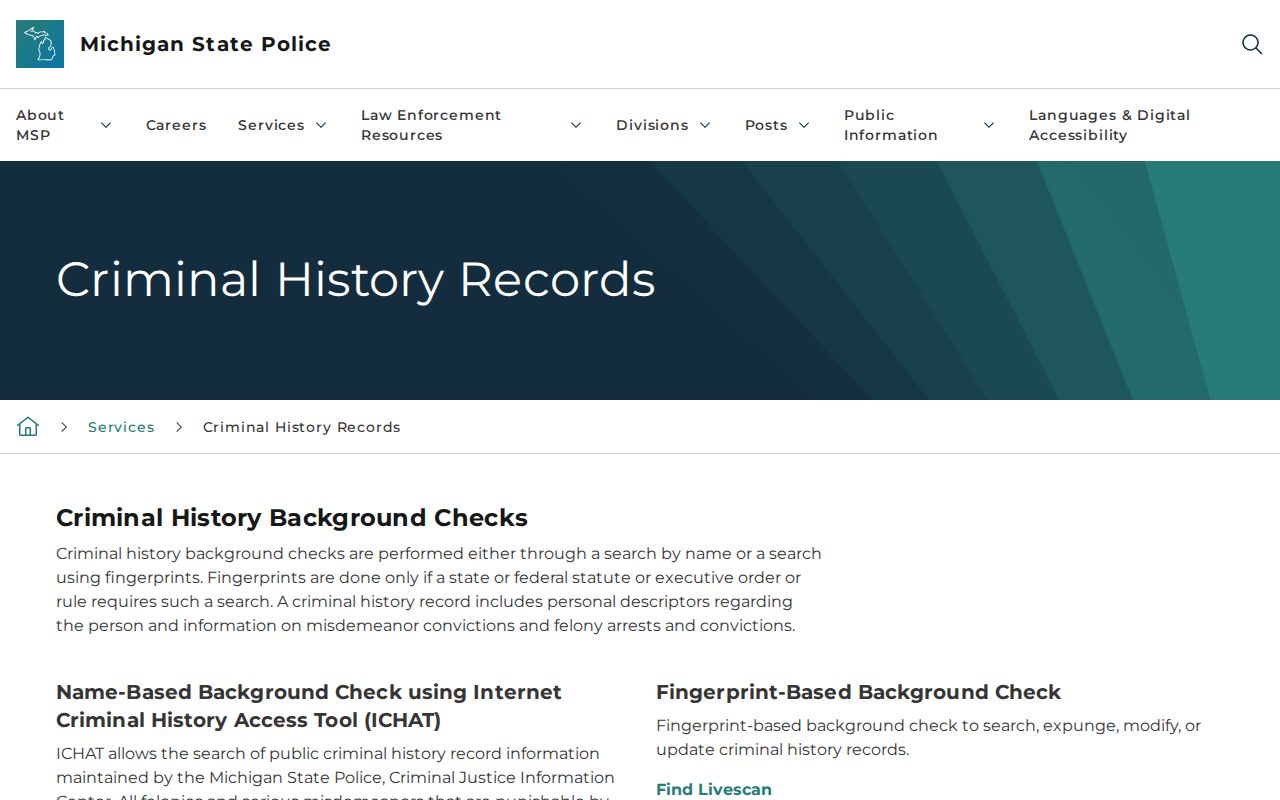
For review of one's own Michigan record, a resident can obtain prints on RI-008 through local law enforcement and mail the card, cover letter, and $30 payment to MSP CJIC. Processing and mail delivery are estimated at three to five weeks. The response includes public and nonpublic Michigan history tied to the submitted prints.
Antrim County Sheriff Record Access
The local office is correctly called the Sheriff’s Administration Office. The county does not advertise a separately named Records Division. Its lobby at 209 Portage Drive, Suite A, Bellaire, accepts FOIA requests and provides accident reports, civil service, sheriff sales, handgun-purchase permits, and notary service. Regular office hours are 8:00 a.m. to 4:00 p.m. Monday through Friday. The vestibule remains open and monitored at all times, but that does not turn it into a round-the-clock records counter.
The official Antrim County site is the source for the county directory and public office routes shown here.
The directory helps distinguish the sheriff, jail, clerk, district court, prosecutor, and county administration. Send a sheriff incident or arrest request to the office that created the record rather than to a general statewide search.
Sheriff Administration
209 Portage Drive, Suite A
Bellaire, MI 49615
231-533-8627
Monday through Friday, 8:00 a.m. to 4:00 p.m.
County Clerk
203 E. Cayuga Street
Bellaire, MI 49615
231-533-6353
Monday through Friday, 8:30 a.m. to 5:00 p.m.
86th District Court
205 E. Cayuga Street
Bellaire, MI 49615
231-533-6441
Monday through Friday, 8:00 a.m. to 4:00 p.m.
Types of Criminal Records
“Criminal record” can mean several Antrim County records made at different points. An investigating agency creates the incident report. An arrest record documents custody and alleged offenses, but not guilt. If a person is lodged, the jail creates a booking file. The prosecutor decides whether and what to charge. The court then creates a numbered case file with its register of actions, orders, outcome, and sentence. MSP and MDOC compile separate state records from reports sent by local agencies and courts.
- Arrest and booking records: agency and jail files about the incident, intake, bond, custody, and release.
- Criminal court files: complaints, filed charges, hearings, pleas, rulings, dispositions, and sentences.
- Repository history: the public or fingerprint-based Michigan record maintained by MSP CJIC.
- Warrants: court or law-enforcement authority that ICHAT and OTIS do not verify.
- Supervision and registry records: OTIS, probation or parole files, and the distinct Michigan Public Sex Offender Registry.
The full progression of filed allegations and court outcomes belongs in the Antrim County criminal court case record, not in a booking entry. A booking charge can be changed, reduced, dismissed, or replaced later.
Antrim County Has No Booking Search
No official public Antrim County inmate search, booking log, or roster was found on the county website during research. That absence matters. Unofficial jail pages cannot fill the gap because they may be stale, incomplete, or detached from the record custodian. For current county custody, call the Antrim County Correctional Facility at 231-533-8627. For a releasable booking record, contact the facility or Sheriff Administration and use the sheriff or county FOIA path if staff cannot provide it routinely.
Next, check MiCOURT after arraignment data appears. Use ICHAT later for its repository scope. OTIS is not a recent-arrest tool and does not include county-jail inmates. The dedicated Antrim County arrest history explains these agency, jail, and court routes in greater depth.
Note: A missing online roster is not proof that no person is in Antrim County custody.
What an Antrim County Criminal Record Shows
An official criminal-history response may group details into an arrest cycle. Read from identity and arrest through the prosecutor and court outcome. The arrest label is not the last word. A dismissal, acquittal, amended count, conviction, or sentence may appear later. The local court still holds pleadings, signed orders, and the full register of actions that a statewide summary does not provide.
| Name & Identifiers | Full name, aliases or prior names, date of birth, and reported personal descriptors. |
|---|---|
| Arrest Data | Arresting agency, arrest date, submitted offense, and related identifiers where reported. |
| Charges & Statutes | Offense description, Michigan citation or code, and prosecutor or court charge information. |
| Disposition | Conviction, dismissal, acquittal, or another final outcome reported by the court. |
| Sentence | A sentence summary; detailed fines, costs, restitution, and orders remain in the court file. |
| Custody / Supervision | Separate jail, OTIS, probation, or parole sources may show current status within their limits. |
ICHAT is not a document store and is not a public photo gallery. Court copies and certified judgments must come from the clerk. Current custody begins with the jail, while state custody and qualifying supervision belong to MDOC.
The Antrim County Correctional Facility was built in 1955. Later renovations increased capacity and helped meet Michigan Department of Corrections rules. MDOC rates the facility for 56 people. Its staff also transports prisoners, handles court security escorts, and supports the daily link between custody and the courts. GUARDIAN RFID devices now help staff monitor people inside the jail, but that internal system is not a public real-time locator.
The county’s jail facts place the current facility at 207 E. Cayuga Street in Bellaire, next to the court campus. Calls and email can address current custody or allowed record questions. The jail is staffed continuously, while Sheriff Administration maintains set weekday lobby hours for routine services.
The history explains why proposed public-safety modernization has drawn county attention. Until an official move or opening is published, the existing Bellaire address and sheriff number remain the correct Antrim County record route.
Public Access Laws
Michigan uses different access rules for executive records, court files, and statewide criminal history. The Michigan Freedom of Information Act covers nonexempt records held by bodies such as the sheriff and county administration. A written request must describe the desired record well enough to find it. Court records follow judiciary rules instead of ordinary county FOIA when the County Clerk acts as circuit-court clerk. MSP may release the public part of Michigan criminal-history information while keeping suppressed or legally nonpublic material out of ICHAT.
Key laws and rules:
Michigan FOIA, MCL 15.231 states the policy favoring access to nonexempt public-body records.
MCL 15.235 sets the response structure and general five-business-day deadline.
MCL 15.243 permits listed privacy, investigation, security, and other exemptions.
MCL 28.242a authorizes public criminal-history dissemination through MSP.
Michigan court-record rules govern access to clerk-held judicial files.
A response deadline is not a promise that every Antrim County record will arrive in five days. The office may grant, deny, grant in part, or take a permitted extension. Redaction may protect private, victim-sensitive, juvenile, active-investigation, or security material.
Antrim County FOIA Record Process
The County Administrator is the Antrim County FOIA Coordinator. Requests may be emailed to FOIArequest@antrimcountymi.gov, delivered to Room 204 at 203 E. Cayuga Street, mailed to P.O. Box 187 in Bellaire, or faxed to 231-533-8111. Put “FOIA” or “FOIA Request” in the subject or on the fax cover. Include names, dates, the likely department, and a clear description. The county form is optional.
The county may ask for half of a good-faith estimate when projected fees exceed $50. An eligible indigence affidavit can waive the first $20, and charges may be reduced when release primarily benefits the public. A denial must state appeal rights.
The county FOIA procedures supplied the official record-request view below.
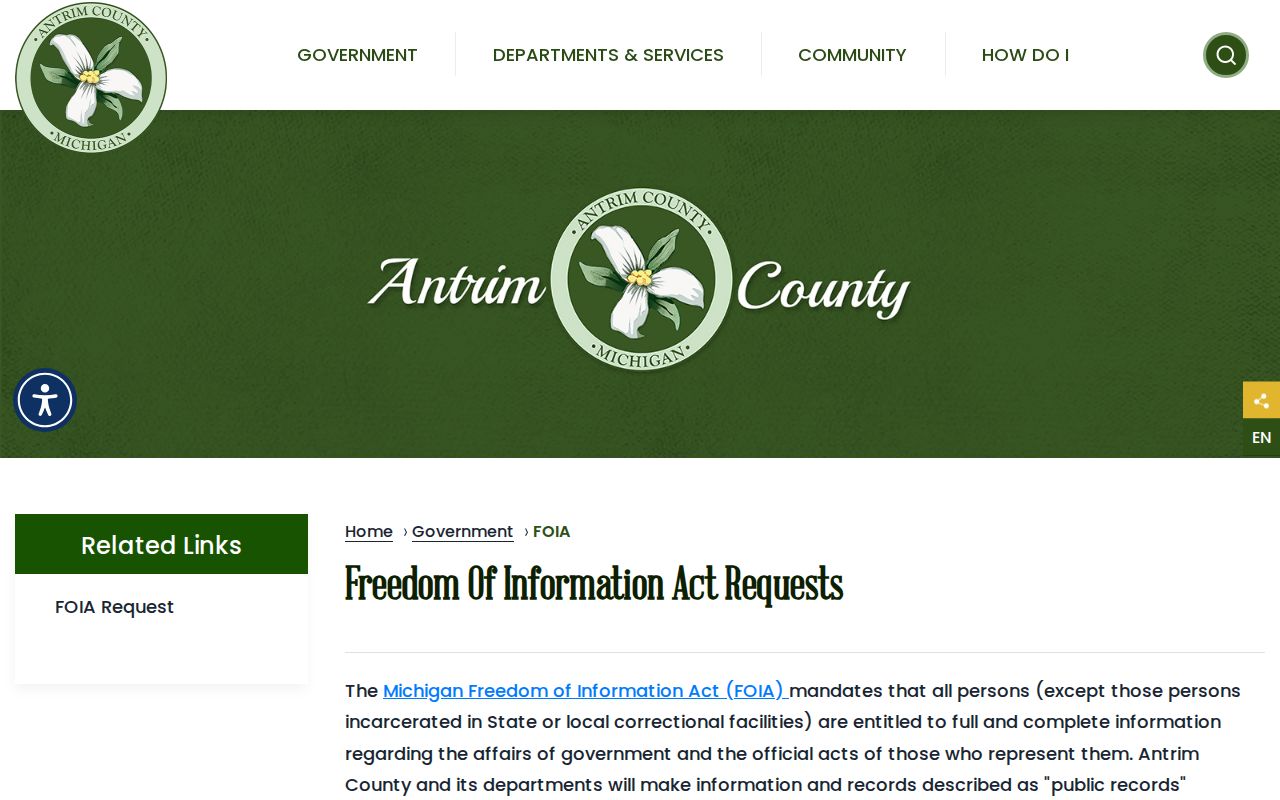
Use that route for county executive records. Ask a court clerk directly for a judicial case file instead of labeling the request as county FOIA.
Antrim County Records Reach MSP
A reportable arrest begins with the arresting agency and biometric data. Michigan law makes MSP the statewide identification repository. The prosecutor then decides what charge, if any, should be filed. The district or circuit clerk reports the final disposition, including conviction, acquittal, dismissal, and sentence or other outcome. That reporting chain links the fingerprint event to the judicial result.
Arrest → booking → charging decision → court case → final disposition → MSP update.
A gap can leave an “open record,” meaning MSP has an arrest fingerprint event but lacks matched prosecutor or court information. It does not always mean the court case remains pending. Names, aliases, and demographic errors can also cause missed or false matches. Compare an Antrim County court record with the repository cycle before relying on the first label shown.
- Disposition
- The court’s outcome, such as conviction, dismissal, or acquittal.
- Open record
- An arrest event missing matched prosecutor or court data in the state history.
- Suppressed record
- Information withheld from ordinary public ICHAT access under Michigan law.
- Bindover
- Transfer of a felony from district court to circuit court after the district stage.
Antrim County OTIS Record Limits
OTIS covers people in MDOC prisons, parole, and qualifying probation, plus those discharged from MDOC supervision within the prior three years. It excludes people not yet sentenced, county-jail-only cases, jail-only sentences, and people outside that discharge window. MDOC warns that OTIS is not a complete background check.
The official MDOC OTIS overview explains the correctional system’s limited slice.
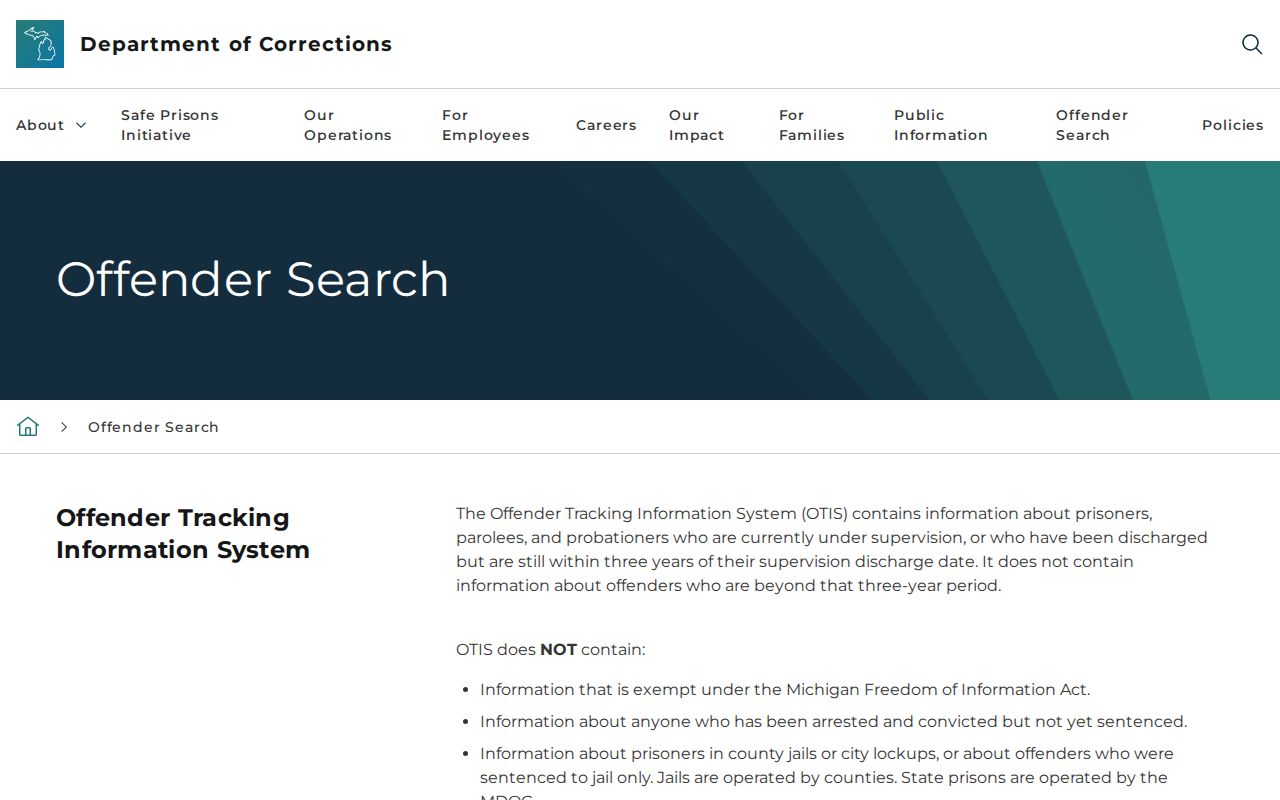
The overview helps readers decide when a state correctional search is useful. It should not replace an Antrim County jail call or court search.
The official OTIS search interface supplied the search-form capture below.
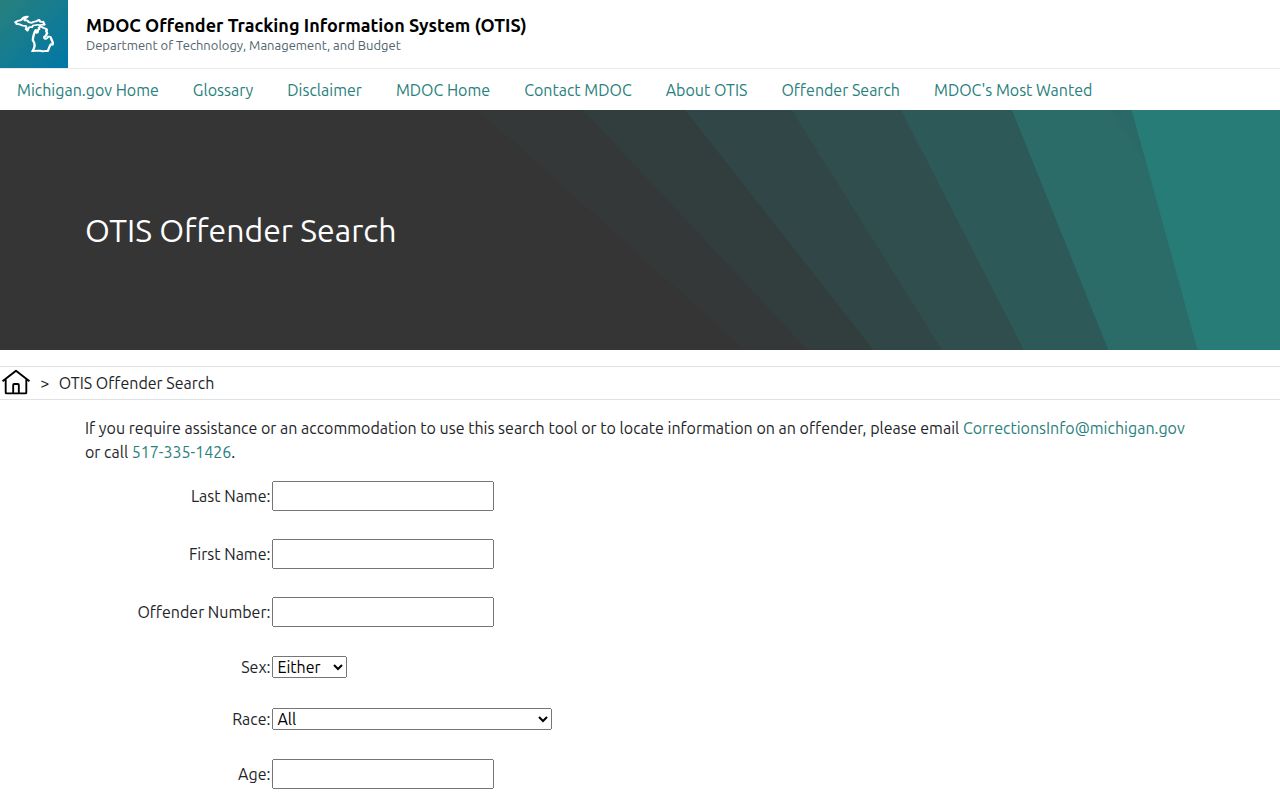
Search by MDOC number when known, or use name and filters such as age, sex, race, status, and marks. MDOC advises changing Offender Status to “ALL” for a broader match.
Sealed, Expunged & Restricted
Michigan’s statutory process is called setting aside a conviction, though state materials also use “expungement.” A set-aside conviction becomes nonpublic for ordinary searches, but the underlying records are not necessarily destroyed or closed to every legally authorized government use. The court of conviction decides an application, and separate courts require separate applications. Juvenile, suppressed, and other nonpublic material also will not appear in ordinary ICHAT results.
Michigan Clean Slate automatic processing began in 2023. Eligible lower-level misdemeanors may clear after seven years, while qualifying felonies may clear after ten years following sentence or completion of MDOC imprisonment, whichever is later. Limits and exclusions apply by offense and record history. An applicant using the paper route sends MSP fingerprints, the application, a certified court record, and a $50 processing payment. MSP advises allowing eight weeks.
After relief, compare ICHAT, a fingerprint personal review, and the court of conviction to see what remains public. A missing or wrong outcome may need correction rather than a set-aside filing.
Correcting Antrim County Criminal Records
Start with the source of the disputed fact. Obtain the register of actions and signed order from the Antrim County court if a dismissal, conviction, or sentence is wrong or absent. For one’s own statewide history, use a fingerprint personal review to tie the record to identity. MSP provides RI-026 to challenge public criminal history and RI-027 for a court that cannot update judicial information electronically.
The Criminal History Helpdesk is available at 517-241-0606 and MSP-CRD-CrimHelp@michigan.gov. If an OTIS conviction detail came from a sentencing court, MDOC directs the correction back to that court. Supervision details should go to the Antrim County Parole/Probation Office at 107 E. Cayuga Street, Bellaire, 231-533-5136.
Do not rely on name alone. Check date of birth, court, case number, descriptors, and the final disposition. Fingerprints provide a stronger identity match than a public name search.
Antrim County Warrants Need Direct Checks
Antrim County has no verified public active-warrant database. ICHAT expressly excludes warrants, and OTIS is a corrections locator. Check MiCOURT for a related public case, then call the issuing court. The 86th District Court Antrim counter handles district and bench-warrant questions at 231-533-6441. The 13th Circuit clerk answers felony-case record questions at 231-533-6353. Sheriff Administration can address sheriff-held information or current surrender instructions at 231-533-8627.
A bench warrant often follows failure to appear or comply with a court order. An arrest warrant authorizes custody, while a search warrant authorizes a search and may stay sealed during an investigation. A docket notation may not be current enough for decisions about appearance or bond. People resolving their own warrant should identify the case number, ask whether an appearance must be scheduled, and confirm instructions before arriving.
Antrim County Courthouse Record History
Bellaire became the county seat after an 1879 vote. The late-Victorian courthouse opened in 1905, and its four-faced clock followed in 1922 after a local fundraising drive. A modern County Building opened next door in 1978. The historic courthouse later became storage before a voter-backed restoration returned court functions to it in 1992.
The county courthouse history supplied this official image.
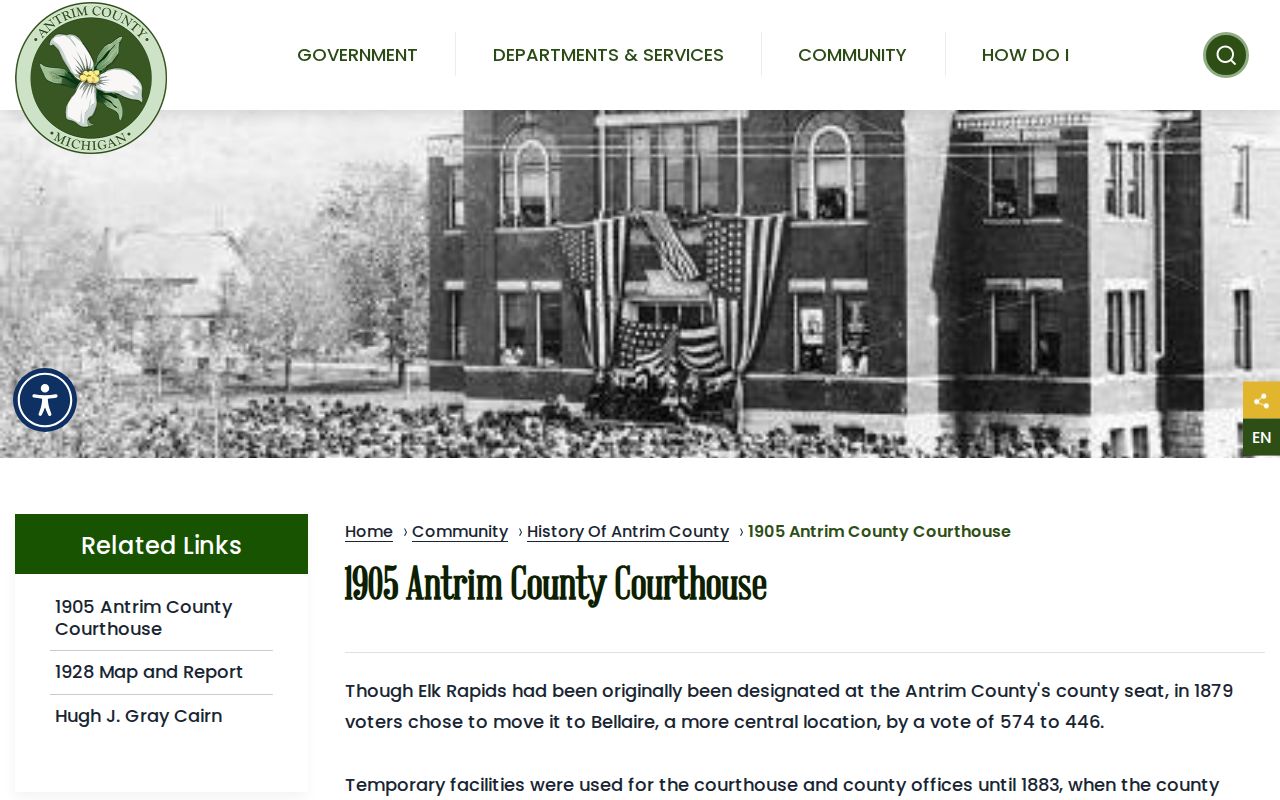
The campus layout explains a common Antrim County record problem. The elected clerk’s administrative counter is at 203 E. Cayuga Street, the district court and prosecutor use 205 E. Cayuga Street, and the jail sits at 207 E. Cayuga Street. Nearby buildings still serve different record roles.
Federal cases do not appear in ICHAT. Antrim County lies in the U.S. District Court for the Western District of Michigan, and federal dockets and filed documents use the federal court and PACER channels. Federal custody uses the Bureau of Prisons locator rather than the county jail or OTIS. Those systems answer separate questions from a local arrest or Michigan conviction.
A person seeking their own FBI Identity History Summary can begin at the FBI electronic request portal, shown in the official capture below.
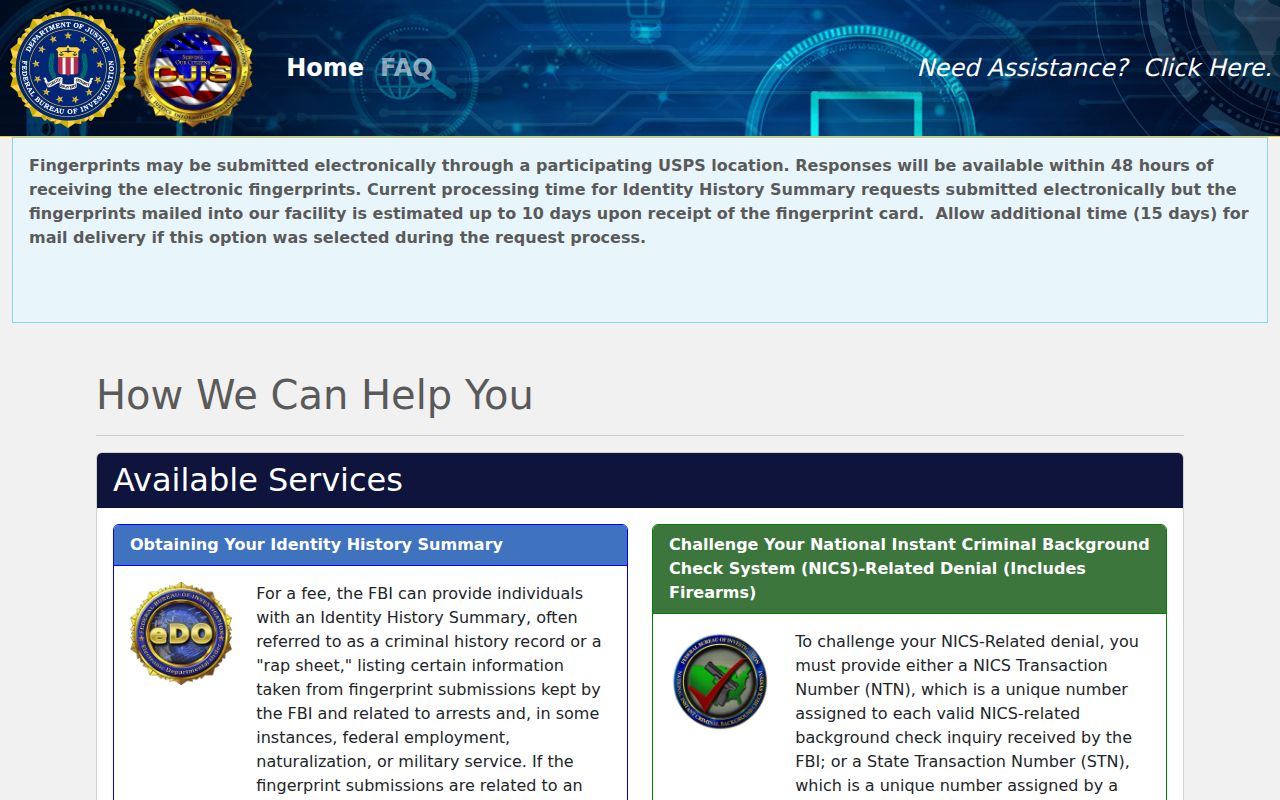
The FBI response is fingerprint based and reflects information reported to the federal repository. It does not replace a named federal case search or an Antrim County court file.
Criminal Records by City in Antrim County
Antrim County has no incorporated cities, so the required local guides follow its three largest incorporated villages. Elk Rapids and Mancelona have village police record channels, while Bellaire combines village policing with the county-seat court and sheriff campus. None has a separate municipal court. District matters route to the 86th District Court in Bellaire, felony matters can move to 13th Circuit Court, and detention records move through the county jail.
Elk Rapids Criminal History
1,529 residents · Village police reports begin on Bridge Street; court and booking records route to Bellaire.
Mancelona Criminal History
1,344 residents · Village police records stay local first, while court and jail files are held in Bellaire.
Bellaire Criminal History
1,053 residents · Village, sheriff, jail, district, and circuit records remain institutionally distinct.
The 2020 Census ranking places Central Lake fourth. Village and township names are not interchangeable in Michigan crime tables, so a local records search should identify both the responding agency and the court location.